
About perfectionism
I had a perfect title but then I renounced perfectionism

Greetings to everyone who is desperately trying to find meaning in their TV, now that the Australian Open has finished! Maybe it helps to know that for me personally - as if leaving the excitement of a Grand Slam tournament behind wasn’t bad enough - I have also come back from sunny, bright Melbourne to grey, old Germany where the sky has one colour and one colour only. Germany’s sky in winter is just a smudgy piece of paper. My plants have perished (except for Paul, he’s a resilient little shit), my yard is clinging on to its last bits of grass.
Humans were not made to switch seasons within a day. They are meant to see the leaves fall and ease into a winter depression not be hit with it over the head. But enough about German winters.
What I really wanted to talk to you about today is perfectionism and what tennis can teach us about it.
Stanley Kubrick was known for re-taking scenes for his films hundreds of times until his actors were on the brink of exhaustion. The scene where Shelley Duvall swings an axe at Jack Nicholson in The Shining? Filmed 127 times (by the end Duvall was presumably swinging the axe at Stanley Kubrick instead). A scene of a family crossing the street? Filmed a relaxed 80 times. You might argue with the method but you can’t argue with the results. Stanley Kubrick is widely recognised as one of the best film makers of all time.
And yet, is there another way? Would’ve 50 takes of Shelley sufficed? I guess, we’ll never know.
If you listen to tennis commentary regularly, there will always come a point where one of the announcers say: “She (or he) is such a perfectionist”. He is never satisfied or she doesn’t leave the practice court until it’s just right. And while that is mostly accurate, it also amazes me to a certain degree, because tennis is the one sport in the world that will beat perfectionism out of you with a racquet shaped stick.
A point is won or lost, a match is won or lost, a tournament is won or left early. Every single tennis match, no matter how well played, is plastered with micro-failures of missed shots and netted serves, of bad decisions and questionable body language. Learning to deal with that is the entire raison d’être of a tennis player. If you don’t learn to accept that errors are part of the sport you chose for yourself, you will succumb to the pressures of it.
So, how is it then that a disproportionate amount of tennis players are still perfectionists? I’m glad you asked.
If you happen to be somebody who likes to have things under control and wants them just right and you’re also a gifted athlete, chances are, you will venture into an individual sport. No matter how soul shattering a lost point, set and match may be, nothing worse for a perfectionist than having to rely on possibly ten other people to resolve an issue for you. After all, it’s not a coincidence that Stanley Kubrick ended up as a film director in Hollywood, not as an actor, or a cinematographer, or a producer. No, he chose the job where he has the most creative control possible on a film set.
And more on the voovoo side, in the realms of Andrea’s debatable theories, I do think that either life chooses a profession for us in which we can become a more temperate self or - if you want to view it from a psychological perspective à la Carl Jung - our unconscious actively searches for challenges for our character in order to become a whole individual. An individual who integrates their perfectionism into something less straining, something that lands just before somebody swings an axe at you.
Maybe it’s striving for the best but acknowledging when it can’t be achieved. A casual reaching for stars but being ok with having only touched the underbelly of the moon. Wanting to write a modern Magic Mountain but settling for Finite Jest instead. All of this while still trying, of course.
Because that is the art, isn’t it? To attempt for the highest of goals, not get lost in the process of it, despair over it in moments of self-pity and French movies, but continue to attempt. Goals accomplished have rarely made anyone instantly happy, but goals not accomplished have always brought forth wisdom.
In short, perfectionism is perfect - as long as it is held in its bounds by our future, better self.
Things that make me happy:
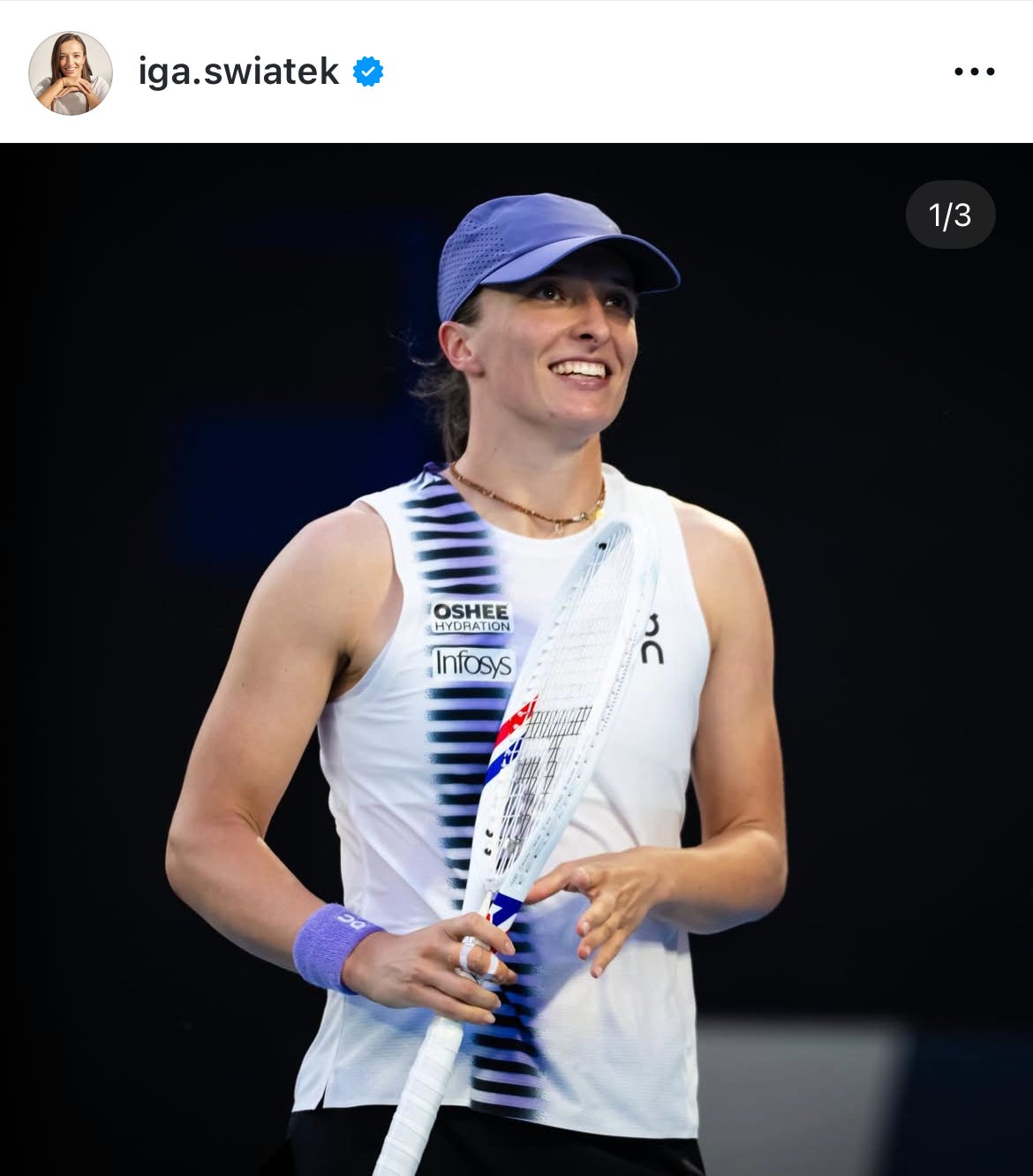
Speaking of perfectionism. While writing this, I spoke quite generally about tennis players when in reality I had one particular tennis player in mind: Iga Swiatek. She is the epitome of perfectionism and what it can do to us if it’s taken too far. Like so many tennis players, her biggest strength can also be her weakness at times. The guy that is stupid relaxed? Probably not a work horse. The girl that is headstrong? Becomes stubborn when the moon is full. What has always made me happy about Iga, though, is that she can’t help but be perfectly (ha!) honest. She is one of those people who think while talking, for whom talking is equivalent to thinking and watching her do it when you ask her a semi-serious question has always been a great pleasure of mine.
Things that make me unhappy:
I’ve been trying to freshen up some of my furniture in my house for a while now. And as perfectionism strikes once more, I'm devilishly afraid of making a huge mistake. So, I’ve been buying Architectural Digest - A LOT. I’m not exactly sure that it makes me unhappy but I have noticed that in all the home stories, people who are presenting their house are always barefoot. I understand that naked feet are supposed to symbolise coziness and domesticity but you not wearing socks is not going to trick me into forgetting that I am watching a highly editorialised photo spread in a magazine. Just saying.

May your week be less grey than mine and may you tame your perfectionism better than Roy tamed that tiger (too far?). Until next week.
Yours truly, Andrea
I loved this quote from Jannik about this idea: “The reason why I chose tennis was, in tennis you can make mistakes. You can lose points but you can still win the match. In skiing, if you make one mistake, one big mistake, you cannot win.”
I absolutely love the way you talk about tennis. And I absolutely agree about Iga. I think that one of the biggest things she's missing is how she wants to take full responsibility for how the match turned out. I read about how Brad Gilbert helped Andre Agassi when he was struggling; it was mostly about being mindful of what was happening on the other side of the net.
I admire Iga, and I always root for her. Not because she's Polish as I am, though (I don't support sportspeople based on the nation they represent). I also believe it's mature and just right to focus on yourself and do your best.
But you have to accept that there will be things you can't control. Your opponent is just better, or you're having a bad day. I think she will be closer to accepting it as she gets older.
Sometimes, wanting something too hard makes it only more distant. I think Coco's struggles are also rooted in wanting it too much.
I loved what Madi Keys said after she won AO last year. For years, she wanted to win a slam but couldn't. And then, she did. I think she said something about how she still wanted it but didn't need it, and that was the change. That's maturity.